“Hidden code in hundreds of models of Gigabyte motherboards invisibly and insecurely downloads programs—a feature ripe for abuse, researchers say.” (1)
This sounds just like the same story I wrote here nearly two years ago (6/22/2023 as I write) about Apple. (2) Except now, we find that a popular motherboard maker is imbedding internet access code in the boot-up software that lets their boards start and run, in motherboards that people use to try to get away from commercial and governmental surveilance by building their own secure machines.
It’s not that this was unpredictable. There has always been a security issue with closed source boot firmware. It has never been fundamentally trustworthy, but a foundation of sand upon which to try to erect a safe and secure computing structure. Gigabyte’s present problem is just one real material example of what is really going on. What other computer builders and chip makers are doing or not doing, we can only guess. How it can be misused, we don’t know. Is it intentional and malicious, or just crappy code? It would be great to see the code and make sure our computers, unlike my MacBook of three years ago, are really ours. And it is absolutely necessary that the computer owner at least has a kill switch on any such code, or else, it’s not their machine.
Well, we can look at some boot-up code. Open source boot-up software is available from coreboot (3). I recently bought a refurbished Lenovo T440p laptop from Minifree Ltd (4) that uses coreboot in a product it calls Libreboot. Some builders include a coreboot option, the StarLite MK IV, for example (5). My experience with Libreboot has been good.
I just (1/22/23) ordered “The Road to Unfreedom: Russia, Europe, America”. I saw a picture of a Ukranian soldier reading the book in a foxhole (posted by the author on Telegram).
The Goodreads reviews of conservative readers were pretty bad (a reciprocal indicator of potential value for me), and I figure the soldier has a much better perspective from which to judge the validity of Snyder’s claims about Putin’s unhinged genocidal goals than the author’s detractors. Those factors make me think this might be worth some time, so off I go.
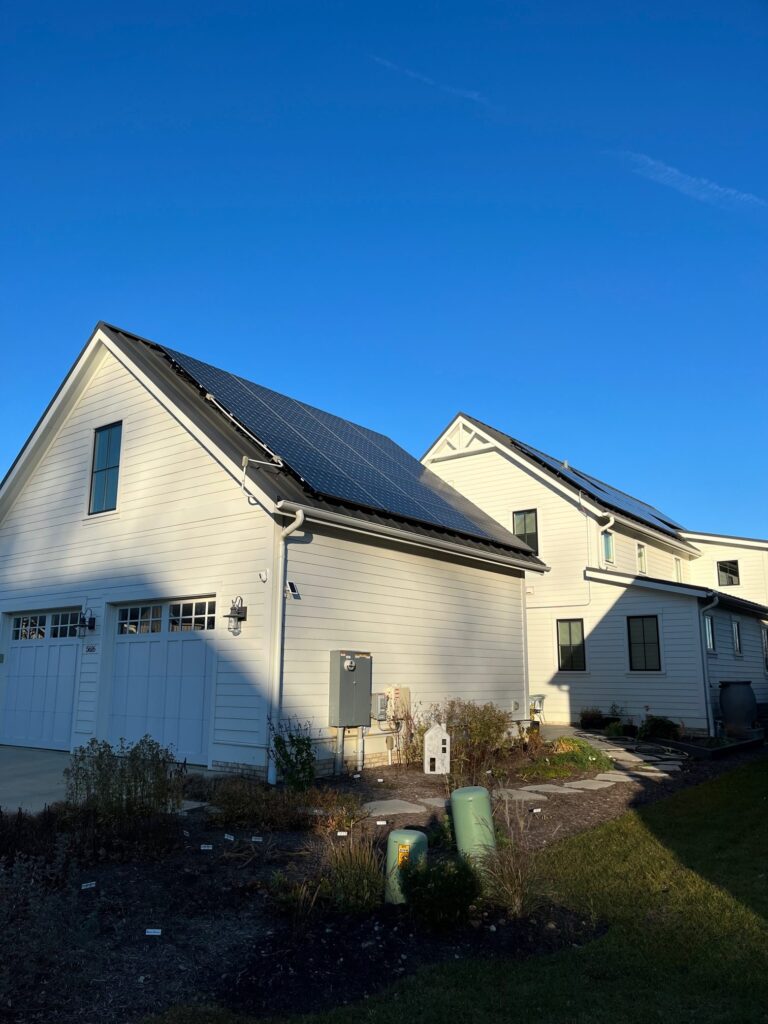
Our three-year-old Legacy House just had a solar PV upgrade. We added 19 panels on the house to make about 100% of our energy. Net metering, no batteries (yet).
Today (7/9/2022) I ran across two videos , one by Jennifer Lawrence (1), and one by Michael Douglas (2) for RepresentUs (3). They were done in 2019. They are great. I don’t know why I have not seen them before. I’m guessing I’m not the only one in the dark.
I’ve been trying to avoid politics here because it has become so irrational and hateful, but this blog is about doing things, and RepresentUs is trying to help us do something this country really needs. The USA is no longer a democracy, if it ever was one. I’ve known that for quite some time. But it’s much worse today than it was not very many years ago. At the federal level we elect our only truly representative legislative body (The House of Representatives) from gerrymandered districts that thwart the popular will. The Senate, though elected, is not representative of the people by design. And, the Supreme Court has become a third appointed legislative body.
RepresentUs has a proposed Anti-Corruption Act that touches almost every political worry bead that I’ve massaged for the last 25 years (4). I’m not going to say much more about it here, but I encourage everyone to check out the links below.
We are in serious trouble, and RepresentUs is showing us how to get out.
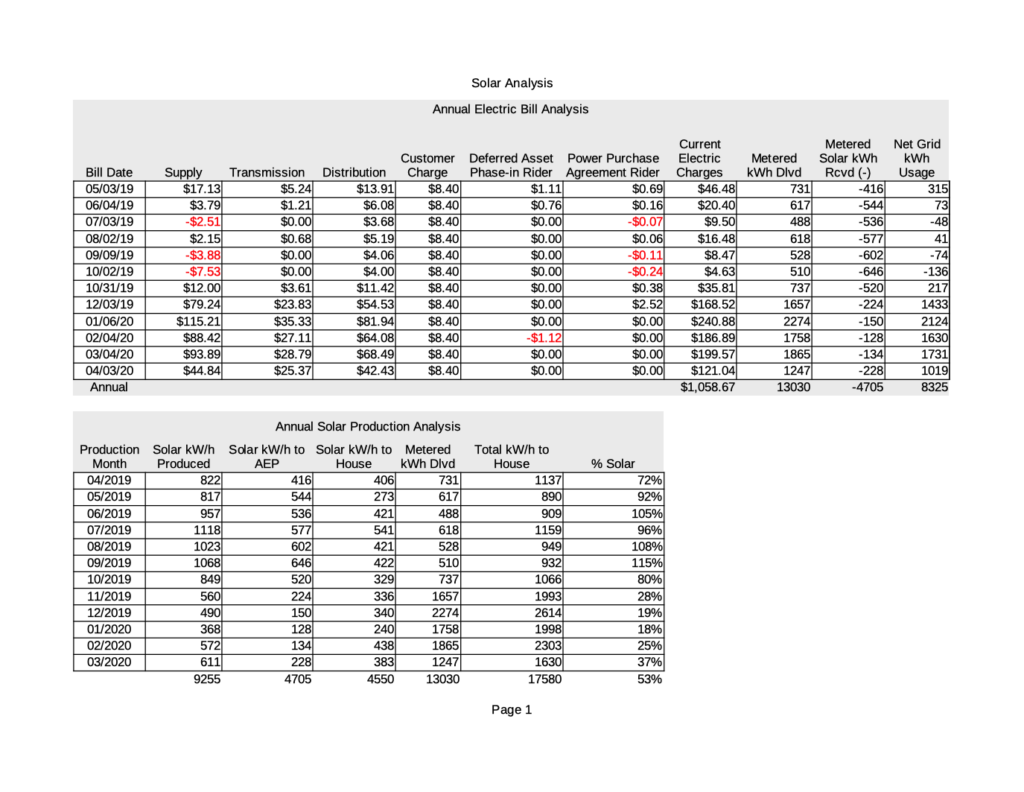
The first 12 month’s energy consumption and cost numbers are tallied. While I was a little disappointed with the raw percentage solar, the projected annual cost came in below that expected for the house. The HERS (1) estimate was $950, and we ended up at $1058.67. But — (and BIG but) that annual cost includes one year of driving our electric car. Because the HERS calculations on our basis document do not include a car, as nearly as I can figure we are doing better than expected on total building energy usage, which I really thought we would. The data is below:
The spreadsheet above shows that winter energy consumption is higher, and that central Ohio is a cloudy place during fall and winter. No big surprise on either point. We had originally planned for 24 solar panels, and that might have been a better choice, but we thought we’d wait and see how things panned out. I think we’ll wait another year before putting panels on the main house (just on the garage, now). If we do that we’ll probably go to 28.
We have made some other little changes that may show up in the next 12 months. The hybrid water heater has recently been switched from hybrid operation to heat pump only operation. We see no difference in hot water availability, and that should reduce power use. We have also switched to a renewable power generation supplier. That lowered supply costs a bit and makes us totally renewable.
We finished our first “high performance” home in 2019. It is at Evans Farm in Lewis Center, Ohio. We live there now. By high performance, we mean low energy consumption, not off-grid. Our first house still costs about $750 per year for its electric utility power, which accounts for about half of the power we use (all-electric, we really cannot use gas, oil, coal, and wood anymore). The remainder comes from solar panels on our garage. Key factors that make this possible are a tight Structural Insulated Panel (SIP) envelope, triple glazed windows, efficient HVAC, efficient electrical appliances, and LED lighting, Our Tesla Model 3 costs about $250 to run for a year, for about 10,000 miles. So, total cash to the utility is about $1,000 per year (1)
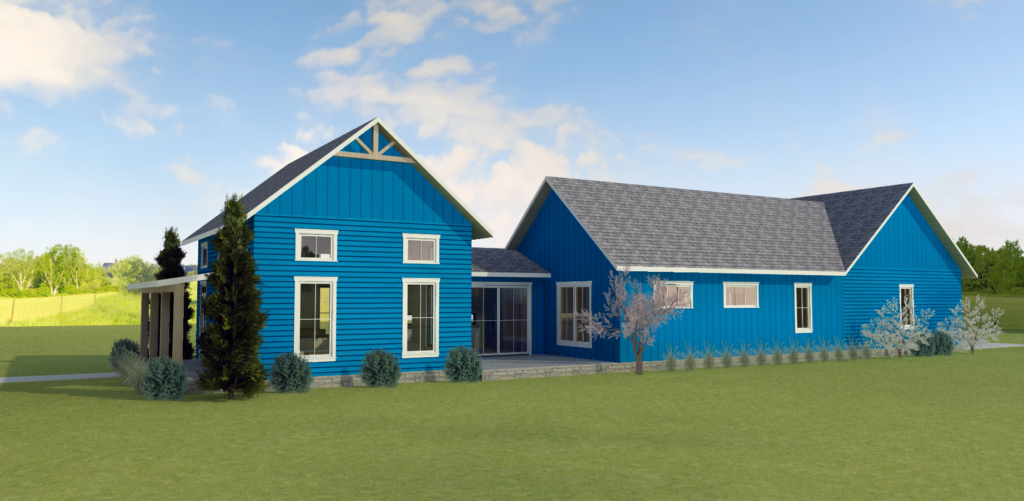
Our good experience with our home encouraged us to build another home for sale as a way to push this better technology out into our community where people could see it and learn about it. We started that second house, a 3 bedroom ranch with basement, early in 2021 and finished it in October.. It sold before it was done. The November electric bill (house is all-electric) was $97. That is right on target. Summer 2022 should see some negative bills.
We learned many things about home building on the second house project, and chief among those was that it is possible to build high quality, efficient homes for not much more than conventional timber-framed structures. Yes, it will cost a bit more. Perhaps 5% more, but we really can’t afford not to spend that 5% given the environmental crisis we are presently experiencing. That money will come back to the occupants quickly, very likely making the slightly higher mortgage payment and utilities combined even lower overall. Every new home should be a high-performance home.
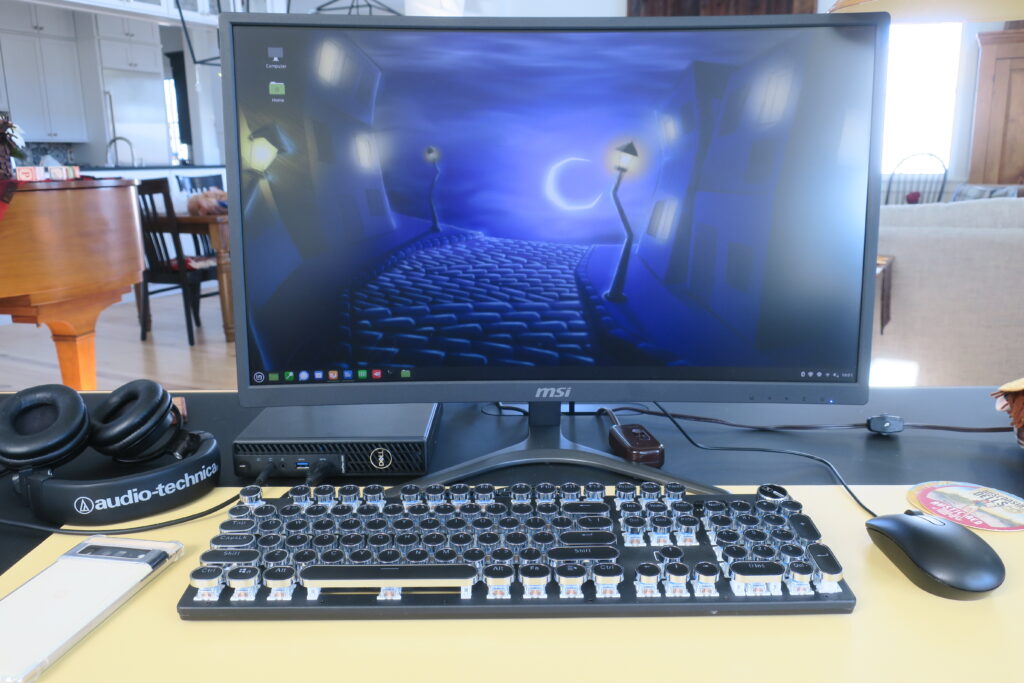
I have been an Apple fan for many years. Most recently using a lovely MacBook Air (M1), a beautiful blue iPhone 12, and an iPad Air. But no more. This post was written on my Dell 3080 micro desktop running Linux Mint. My new Android Pixel 6 is lying by its side (12/12/2021).
I’ve stripped all communications software, contacts, and photographs from my iPad, and use it only for media playback and browsing. The MacBook and the iPhone are gone. Making this move was a difficult decision because the finely crafted Apple stuff worked really well and worked really well together, automatically. That’s not always the case in the Linux or cross-platform worlds. It took days to get calendar syncing working between Apple (family members), Android, and Linux devices, and to do that I ultimately had to move all my calendars to a third party cross-platform system, Cozi, which works very well.
There is a lot more “grit” in my new setup and a lot less “honey”. But, in the IT world grit can be good. By that I mean that there are defined open interoperability standards governing exchanges between functional apps. Those standards increase our security and privacy. We get addicted to information technology “honey”, you know. We forget about what we are giving up to get the smooth, sweet interoperability that comes with broad closed systems like Apple’s. Or Google’s. Or Microsoft’s. Tight integration through webs of almost impenetrable code can create security and privacy problems. It can hide things. It is complicated and exclusionary. Interoperability should come through open standards.
So what happened to make me go to all this trouble and expense? Not just the grit vs honey thing. My concerns began to rise with Jeffrey Paul’s November 2020 blog article, “Your Computer Isn’t Yours” (1). Apple’s honey pot was starting to overflow. It was becoming clear that my Mac really wasn’t my Mac anymore. It was increasingly just a hardware device connected to Apple’s iThing universe. I was losing control as to what software ran on it.
Then, in 2021, Apple announced decision to install a CSAM (child sexual abuse material) scanner on Apple devices (2, 3, 4, 5). Now, there is no CSAM on any device I own, so this was not a practical concern for me, and I didn’t care much what they did in THEIR iCloud because I could always (and did) encrypt important stuff (not CSAM) with my own tools before I put it there. But, philosophically, I cared a lot what they did to MY computers. A line had been crossed.
I also cared about the practical safety and even the lives of Apple device users who live under repressive regimes like those in Russia, Belarus, Syria, Iran, China, and even Texas (with its new take on Red Guard-like vigilantes) or Florida (with the Governor’s proposed new private volunteer army) (5). That’s the hot-flowing-blood-real problem. What happens when one of these governments says to Tim Cook, “You already look for CSAM, it should not be difficult to find who is saying bad things about our glorious leader. Here is a new law requiring you to do that.” Well, we already know the answer to that question because, for all practical purposes (China’s requirement for government controlled local servers), it has happened (6).
What might nation-state hackers do with Apple’s new “backdoor” code? We don’t know, but Apple is on a steep slippery slope and I choose to let them take the slide by themselves. I’ll not help them make a big mistake, and I’ll accept the pain required find new ways to get things done even if they are not quite so pretty. I’ll gain standards grit while I’m at it. Grit that can protect me from lazy information systems practices and the security and privacy weaknesses that come come with them.
So, the iPhone had to go. I chose my new Pixel 6 Pro phone because Android is more open to scrutiny than IOS. I don’t know that there is no “big brother” scanning going on on this device, but I find no evidence to suggest that there is. Certainly not an open admission. I chose to use Linux Mint Cinnamon on a Dell Optiplex 3080 micro-desktop that replaced my MacBook Air M1 (8) because Linux is as open as presently possible, and Linux Mint Cinnamon is about as refined as Linux comes (a lot like Windows XP). My existing ARM Pinebook Pro laptop (9) fills in for the Air when I have to be on the move. I use Manjaro/KDE Linux on the Pinebook.
There are thousands of eyes pouring over Linux Mint and Manjaro code every day. I have virtually total control of data management with a high degree of trust under these operating systems. It’s taken me a week to make the switch, mostly time required for moving and cleaning up data, and while there is more to do, I think I’m fairly well settled in. Linux Mint has come a long way since I last saw it. It found my Brother printer/scanner all by itself, just like Windows, and both functions work perfectly out of the box. Signal serves as my cross-platform messenger. Thunderbird does the mail. LibreOffice is all I need for writing, spreadsheets, presntations, and the like.
Today, even though I may have to shift gears manually sometimes, I have really good control of MY machines. Not the other way around. iPrivacy.
I have been watching Tesla’s Plaid release video’s for the last few days (6/12/2021). They were hard to miss, really very interesting, and I’m fine with what I’ve seen, in context. I own a Tesla Model 3 Dual Motor LR. Love it. But, we really don’t need many Plaid Model S cars, and, fact is, we won’t get many. I’ll never have one.
The Plaid Model S is a magnificent technology development project for Tesla. Good for business. Importantly, it projects leadership and power. It is a poster child (1), and that’s its context. However, in service the Plaid S is just a 390 mile range toy that gets to 60 mph in about 2 seconds. It is very expensive, and for that reason alone cannot urgently and directly help us solve our number one contemporary human survival problem, global warming.
Climate-wise, we need practical long-range carbon-free vehicles that we can afford to buy. Sadly, they are not here yet. But, there is hope.
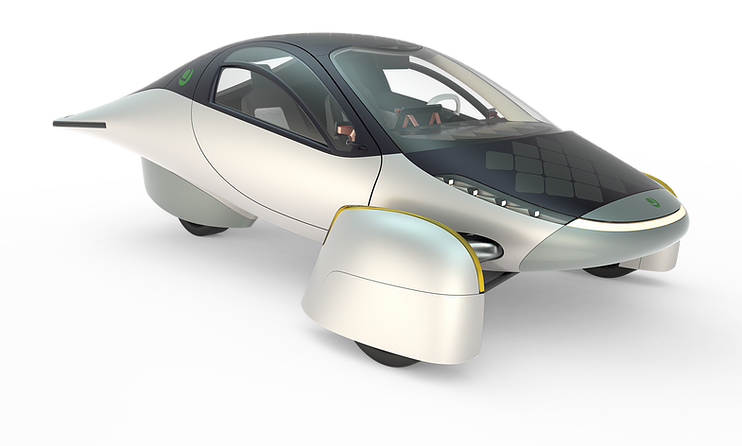
Oddly enough, there was a fledgling company called Aptera Motors (2) putting on a show at about the same time as Tesla’s Plaid reveal. I suspect very few people watched Aptera’s webinar. Their car, the 1000 mile range (show me) Sol (current alpha version name), is a total departure from contemporary automotive design. The minimalist Sol could bring costs down to where common folk can participate in the greening of private transportation, even if it takes a lethargic 3.5 seconds to get to 60 mph. My Model 3, by the way, takes about 1 second longer, and it can be quite scary.
I’ve placed my deposit on a Sol-like production car, and hope I live long enough to complete the purchase. Aptera plans to start production this year, maybe next. We’ll see. The general simplicity of the vehicle and its composite fuselage may make that possible, may make it possible to avoid Elon Musk’s Model 3 manufacturing hell.
But, one thing for certain, while I am sure the Plaid is an absolute blast to drive, it cannot help solve the big problem. It’s at the wrong end of the solution spectrum. Aptera is at the correct end, maybe too close to the end for some, but at the correct end.
It had to happen, of course, and I have no problem with it. That is, those of us who drive electric cars have not been paying for road use. While that might have been be OK for a while to stimulate electric car development, it was not sustainable – particularly with all these new Teslas whispering around. Gotta fill those pot-holes and prop up those bridges. Ohio now requires a surcharge of $200 per year to register an electric car. We just paid ours. Other states are beginning to do this, as well, but the Ohio surcharge is at the top of the range. (1) So, I wondered how our car compared with gas cars under this new scheme.
Here is what I found:
For a normal year, Ohio seems to have a fair scheme, and contrary to some complaints I had heard and read, (2)(3) electric cars are not costing more in road taxes than gas and oil burners. Tax-wise in Ohio we’ll still be about $130 a year cheaper on average. It seems to me that this scheme must be much easier and cheaper to administrate than the gas pump tax method. So maybe it’s a win-win. (4)
And, let’s not forget that electric cars are, first — cheaper to run quite apart from the tax issue (which really isn’t an issue) and, second — an essential part of solving the climate crisis. We really have no choice.
I was walking in the neighborhood yesterday (04/03/2020) and it struck me how bright and clear the sky suddenly was. Of course, that’s because people have been driving much less. (1) We are staying close to home as a result of COVID-19 travel restrictions.
There is a teaching moment here, and that is that we have been dumping easily noticeable amounts of fossil fuel junk into our atmosphere for 100 years or so, and it’s piling up. A lot of that dull brown cast on the horizon we are used to seeing comes out of car tail-pipes, and it’s pretty well dispersed right now here in Lewis Center, Ohio. Just think how much better things will be when we are all driving renewable sourced electric cars, and the planet has had some time to cleanse its lungs.
Though they complain, car makers can meet the 2025 CAFE numbers. Hyundai, Kia, Mazda, and Toyota can pretty much do it today. But, the real answer is not better fossil fuel economy, it’s electrification. Maybe we should just stop all combustion engine car manufacturing in 2025, instead. It’s not a new idea. (3)